In 1987 a serial killer by the name of the “Sweet Sixteen Killer” murders three teenage girls in a small town. Thirty-five years later (in that same town) the killer is back, murdering the mother of Jamie Hughes (Kiernan Shipka). Jamie then accidentally travels back to 1987 in an attempt to stop the killer.
Strongly implying that this is Scream meets Back to the Future makes the film sound better than it is. Sadly, Totally Killer is not well written enough to hit the high bar it’s set for itself.
It’s still a somewhat fun and passable horror/comedy, where some jokes work while others don’t. Directed by Nahnatchka Khan (Always Be My Maybe), the kills are well filmed and the story never drags. Khan also unsurprisingly and quite smartly leans heavily into the 1980’s visuals and pop culture references, which will certainly make this movie more entertaining for those who become instantly enchanted by anything 80’s related.
Final Thought: There are flashes of something a bit more elevated dispersed throughout, mostly in the idea of how time is dealt with in this particular world. But outside of that, this is an average and completely watchable October flick.
Follow me on X (Twitter) @moviesmarkus and Instagram @moviesmarkus1
The true story of José Hernandez (Michael Peña), a Mexican immigrant who grew up to become an engineer and eventually the first former migrant worker turned NASA astronaut.
Definitely full of heart and eager to showcase a specific Latino community/culture, director Alejandra Márquez Abella builds a world that feels warm and familiar. The vibe here is very much Latino biopic meets Disney live-action. If that sounds like your kind of movie, then A Million Miles Away will be a more than satisfying experience.
Before I get to my lone hangup, I do want to mention that there are things that I (as a Latino) really appreciate about this film. The fact that most of the familial dialogue is in Spanish, a soundtrack which perfectly drives home a particular nostalgic feel and the chemistry between actors Peña and Rosa Salazar (who plays Adela, the wife of Hernandez) all work to create a far better viewing experience than I’d initially anticipated. My only criticism of a film like this is that it is family friendly to a fault.
I dislike using “family friendly” as a pejorative. But when what we get is a story about a man who worked in the fields with his family, then worked in an office building where he was seemingly the only brown face, and then enters the space program against all odds, and the end result feels instantly watered down, the term “family friendly” in this instance will translate into an unnecessarily corny viewing experience for some. Every hardship Hernandez goes through is addressed with a PG rating in mind, and at times I felt like I was watching something more interested in driving home an inspirational message, rather than showcasing an authentic story. While I do appreciate that movies like these are made about important and often forgotten historical Latino figures, the subject matter here warranted more cinematic authenticity and grittiness.
Final Thought: There is a place for movies like these. A family movie night perhaps. It wouldn’t surprise me if a year from now A Million Miles Away was playing in elementary schools during Hispanic Heritage Month. Hell, I’m quite sure once my Mexican mother sees this movie, it will be her favorite film of the year. And there is nothing wrong with any of that. A movie made with good intentions, love for its characters and clearly engaging enough to disregard the telegraphed nature of the story beats, this is a film I’d feel good recommending. I simply want to praise this more than the film will allow.
Follow me on X (Twitter) @moviesmarkus and Instagram @moviesmarkus1
Is there such a thing as a soulmate? Is there such a thing as fate? In writer/director Celine Song’s feature debut, she examines these notions when telling the story of two childhood sweethearts, Nora (Greta Lee) and Hae Sung (Teo Yoo), who are separated when Nora’s family leaves South Korea. They lose touch but not their connection, as throughout the years they correspond via the internet, holding on to their unwavering attraction. It isn’t until over twenty years later that they mutually agree to meet when Hae Sung decides to travel to New York, where Nora now lives with her husband Arthur (John Magaro).
More than just your average love triangle drama, Song creates a quiet masterpiece, which through her characters, her direction and some stellar performances, tells the story of the passage of time as it pertains to the fate of two individuals. It’s not until the second half of the movie that these two see each other as adults, but during every moment Nora and Hae Sung share the screen, Song constructs a space where the world falls away and her characters are allowed to live the purity of their bond, albeit knowing that at any moment the real world will come crashing down upon them as time moves forward.
Told from the perspective of a first-generation immigrant living in America, the love Nora has for both men (her husband and her first love) in her adult life should also be seen as the symbolic struggle of someone with one foot in two cultures. This is a movie which explores the ever-present love for one’s home (the culture one grew up immersed in) and a new land that one wishes to plant their roots. The idea of having two names (one being an “American” name). The idea of having two lives, where two different languages are spoken. It’s all examined here through some of the most beautiful cinematography and direction I’ve seen all year, capturing Song’s grander themes regarding how devastating life can be, not solely through character dialogue, but glances and body language, and how her characters are framed on-screen at any given moment.
Final Thought: Holding true to its thematic concepts of the allure of forbidden love, the idea of fate and our cultural connection between the past and present, “Past Lives” is both visually and tonally brilliant enough to be considered a theatrical cousin to a movie like “In the Mood for Love”. And that’s arguably the best praise I can give it, so I think I’ll stop there.
Follow me on Twitter @moviesmarkus and Instagram @moviesmarkus1
A huge reason “The Blackening” works as well as it does is simply because the humor within this horror/comedy written and directed by Black people, is made for Black people. This statement may seem obvious, but with it I only mean to say that this film has no real desire to commodify Blackness for a white audience, like so many mainstream Black comedies tend to do.
Synopsis: A group of Black friends (Antoinette Roberton, Dewayne Perkins, Siqua Walls, Grace Byers, Melvin Gregg, X Mayo and Jermaine Fowler) reunite in a cabin in the woods to celebrate Juneteenth. During their stay, they discover a board game that looks racist as hell called “The Blackening” (and hilariously referred to by the group as “Jim Crow Monopoly”). At that point they are forced by a mysterious masked killer to play said game, where the object is to determine who is the “Blackest” and therefore who should die first.
Admittedly, as a Black man I walked into this film with much trepidation. The trailers looked cringy and buffoonish. And the tagline which read, “we can’t all die first” referring to the horror stereotype of Black characters always dying first, seemed like the setup for a single-joke premise elongated by a smattering of low hanging fruit comedy, depicting Black people put on screen solely to be laughed at.
But fairly early on my expectations were subverted. After about ten minutes into the movie, with the introduction of actual three-dimensional Black characters and a slew of well written and very targeted jokes, “The Blackening” quickly establishes itself as a more than worthy horror/comedy with an engaging whodunit throughline. Not to say that there aren’t any cheap laughs, but not for one moment did I feel as though I was stuck in a theater watching an improv group.
Final Thought: For me this felt like “Scream” for the Black community. Yeah, I said it. Meaning, it’s a movie that could’ve been “just another slasher”, checking all of the boxes, but instead chose to do something more. To engage in some meta-cinema with a specific audience, never taking a moment to explain the bulk of the jokes or handhold the uninitiated; trusting that the material is strong enough to entertain everyone in the theater. “The Blackening” is a movie with familiar horror/comedy aspects, but unapologetically centers Black audiences. And it’s more than good enough to create its own distinct spot within the genre. That’s right, director Tim Story’s name can finally be attached to a good movie.
Follow me on Twitter @moviesmarkus and on Instagram @moviesmarkus1
The story is pretty much the same as it’s animated source material. A curious teenage mermaid named Ariel (Halle Bailey) ventures to the surface world and falls for a prince. She then trades her voice to a sea witch in exchange for legs, all for some man.
These Disney live-action remakes have always been set up for box-office success, having a fanbase which miraculously doesn’t seem to care if these films are simply shot for shot remakes, as long as the songs are there and the vibes are right. And while “The Little Mermaid” is not a shot for shot remake whatsoever, all the most memorable visual aspects of this remake are the shots that keep true to the 1989 animated original.
For a remake which is almost an hour longer than the original, director Rob Marshall does a good job of keeping this two hour plus film moving at a pace which accounts for a child’s attention span. And his interpretations of some of the most beloved musical numbers in the Disney canon, will be received well by audiences.
To account for this extended runtime, we get new songs with music from Alan Menken and lyrics from Lin-Manuel Miranda. Some of which are catchier than others, but all fit the atmosphere of a more modern retelling of this classic tale. In addition to the new songs, more backstory is added to many of the characters in an attempt to give enhanced motivations. Truthfully, this aspect neither harms nor helps with actual story engagement.
Most importantly, the live-action CGI talking crab, fish and seagull are done well enough to not be a distraction. I’m being facetious, but also, I understand this is a worry which sits in the back of the minds of non-child viewers who become fixated on these very things. The only issue I have with the visuals is somewhat of a bad timing thing, as the underwater CGI is made underwhelming due to the recent release of “Avatar: The Way of Water” and the technical comparisons these scenes are sure to garner. I must restate that the direction here (while the weakest aspect of this film) is fine and will only be picked apart by critics. My criticism of Marshall’s vision is that he doesn’t seem to have one that wishes to step out of its predecessor’s shadow. This is not a sleepwalking directorial effort, as it’s all quite entertaining. It just doesn’t rock the boat in any capacity. Which isn’t a bad thing, if that is what you came to see.
All of that said, this version does stand out from the original due to the enjoyment many will get from these performances. Melissa McCarthy as Ursula and Javier Bardem as King Triton are great casting choices and very much filled the shoes of these supporting characters quite well. The same goes for Jonah Hauer-King who plays Prince Eric, very much giving dark-haired Ryan Gosling. Awkwafina is the voice of Scuttle the gannet (not seagull) and Daveed Diggs is the voice of Sebastian the crab, both doing much of the comedic heavy lifting, adding comedic touches which differ from the straight-forward whimsy of the original. The fact is, there are no bad performances. Jacob Trembley who voices Flounder is a complete afterthought, but even his voice work isn’t what I’d call “bad”. Anyway, Halle Bailey’s performance is the main reason to see this movie. She is such star quality, capturing the essence of her character (Ariel) better than any other character in any Disney live-action remake thus far.
Final Thought: The 1989 “The Little Mermaid” was my favorite animated film as a child and so I did go into this ready to enjoy myself, but also ready to be all sorts of unforgiving at the slightest hint of an attempt to ruin my childhood. Thankfully, this version of “The Little Mermaid” was an overall enjoyable watch. And due to the nostalgia evoking musical sequences and Bailey’s performance, “The Little Mermaid” is quite rewatchable.
Follow me on Twitter @moviesmarkus and Instagram @moviesmarkus1
When a Hollywood movie focuses on a marginalized group, more often than not there are large aspects of the story which are sensationalized and exploitative. But thankfully this story was not made for the cisgender gaze.
Synopsis: Monica (Trace Lysette) is a trans woman who after years of being away, apprehensively travels back to her hometown to visit her estranged dying mother (Patricia Clarkson).
This is a story not bogged down by exposition, and we are asked to gather information through nuanced interactions Monica has with the world around her, her sister-in-law, her brother, their children and her mother who may recognize Monica but refuse to acknowledge Monica for who she truly is. Amidst the reality we live in of a violent and ever-present nationwide (worldwide) anti-trans movement, co-writer/director Andrea Pallaoro and writer Orlando Tirado make a conscious decision to present this trans story as a piece of slice of life realism. It’s a decision which pays off.
Trace Lysette, who is on screen for every second of this film, intimately portrays a woman who carries with her the trauma of a tragic situation that is all too common in regards to LGBTQ+ youth. A queer child who is kicked out of the house at a young age; rejected by their own family and loved ones. Now grown and asked to interact with those who’ve ostracized her, Lysette is tasked with giving a performance that is not only personal, but also representative of so many who share very similar stories. And Lysette more than comes through with a powerhouse and award worthy performance.
This performance is paired up with Pallaoro coming through with some of the best direction I’ve seen all year. Initially filming (framing) Monica in a way that felt distant, but not detached, as we move forward in the story we are allowed more and more into Monica’s existence; into her routine, her mannerisms, her body, her job, her anxiety, her motivations, her hopes and dreams, her joy and pain, and the isolation felt by someone alienated from family.
Final Thought: “Monica” is a triumph of trans storytelling. It’s a somber movie about attempted reconciliation and forgiveness in a situation where neither of those things may be an option. It’s a movie which shows the results of parental abandonment. And above all things, it’s a movie dedicated to spending time with a woman who is trans, as she moves through this world. “Monica” is a quiet film that is sure to speak volumes to those who take the opportunity see it.
Follow me on Twitter @moviesmarkus and on Instagram @moviesmarkus1
Adapted from Andreas Malm’s nonfiction book, “How to Blow Up a Pipeline: Learning to Fight in a World on Fire”, in which it is argued that sabotage (property damage) is the most effective form of “local climate activism”, this movie continues in the spirit of its source material, presenting an unapologetic call to direct action.
Synopsis: A small group of young people (some self-proclaimed climate activists, some not) from all across the United States, come together in West Texas with the goal of blowing up an oil pipeline.
Director Daniel Goldhaber drops us right into the action giving his film immediate momentum. Within the first twenty minutes we watch these characters build homemade explosives (Note: no actual bomb making instructions are given in this film) and discuss their plans for the hours ahead. As we witness them prepping for an act which some may call terrorism while others would call self-defense, we are given flashbacks showing how everyone arrived at this point.
Goldhaber along with co-writers Ariela Barer (who also plays the lead character) and Jordan Sjol’s choice to construct this story as a heist-thriller was a stylized stroke of genius, adding an additional layer of tension onto a story containing sky-high stakes from inception.
Very much coming across as a collective passion project, the filmmakers as well as a cast which includes some very engaging performances from the likes of Lukas Gage (The White Lotus), Sasha Lane (American Honey), Jayme Lawson (The Woman King) and Barer herself, take careful consideration in continuously highlighting the revolutionary, communal and anarchist culture and reasoning at the heart of this feature. In the midst of what is a fast-paced film, we are asked to sit with beautiful shots of desert landscape, if only to reaffirm what it’s all for. We get flashbacks that accurately portray how an entire generation could be pushed to these lengths. We even get a pre-title land acknowledgment honoring the native peoples and land that this movie was filmed on. On arrival the collective voice of this film is felt, culminating into something visually and emotionally powerful and creating a sense of solidarity with even the most skeptical viewer.
Final Thought: During said flashback sequences we witness an entire disenfranchised generation surrounded by posters, pop-up social media ads as well as authority figures all suggesting that the only forms of activism that are deemed correct are voting and peaceful protests. And still the characters in this film choose to go the route of non-passive action. “How to Blow Up a Pipeline” asks only one question. What constitutes true and effective activism during a time of immediate crisis? And this question is asked in the most edge-of-your-seat way possible, without sacrificing its “by any means necessary” message. “How To Blow Up a Pipeline” is definitely my kind of heist movie.
Follow me on Twitter @moviesmarkus and Instagram @moviesmarkus1
In this psychological horror, we follow Joséphine (Noémie Merlant), a French woman living in the United States, who is a very successful entrepreneur/model/blogger. Her life is seemingly “perfect”. She has a husband (Kit Harington) and is about to give birth to a child named Ruby. But after she gives birth, Joséphine slowly begins to spiral, suspecting that people surrounding her are suddenly trying to harm her; including Ruby.
One could say “Baby Ruby” is simply about the horrors of having a child, with a smattering of very dark humor concerning the process of caring for an infant. But more accurately, “Baby Ruby” is a horror movie specifically dealing with the theme of postpartum depression. And how playwright turned writer/director Bess Wohl blends these elements together is impressive to say the least, especially for a debut feature.
From the opening scene, “Baby Ruby” is set completely in the world of horror. But the visuals go further than just seeing an exhausted first-time parent. Wohl’s horror inspired visuals work hard to capture the feeling of raising an infant, through the eyes of a woman who is home alone with said infant all day long. For a portion of this movie the only background noise we get is the sound of a baby relentlessly crying. Wohl then presents a world where Joséphine begins to ask for help and is met with dismissive responses that range from, “It’s normal for babies to cry” to a slew of microaggressions masked as advice.
When I say that this has dark comedic elements, nothing in “Baby Ruby” is laugh out loud funny, but more so a satirical critique on the things that are normalized in the United States healthcare system surrounding giving birth and caring for an infant. All of the dark humor scenarios in this have been seen before in your standard comedy about raising young kids. Wohl takes these tropes and plays them not overtly for laughs, but more to illicit anxiety and fear. In its darker moments, the sharply written script addresses the idea of someone believing their baby is capable of being angry to the point of violence, the idea of being angry with your own baby and the idea of being afraid of your own baby.
The performance from Noémie Merlant only adds to the viewers ability to empathize with this character, even when what she is seeing becomes less and less believable. Through the performance we see Joséphine as someone who is thrown into a situation that she is told she will instinctually be able to handle. And even as she begins to sink, is still expected to maintain her “girl boss” persona.
Final Thought: As someone who is never going to give birth, “Baby Ruby” is not a horror movie made for me. I understand that. I also understand that some of Wohl’s punchlines were meant to garner a trauma response only from those who’ve given birth and/or raised an infant. That said, as a childless millennial, I really admire this movie; in its technical construction, its story and most importantly in its willingness to shine a light on some of the darker aspects of the “things we don’t talk about”, that people who give birth go through when raising a child.
Follow me on Twitter @moviesmarkus and on Instagram @moviesmarkus1
Being the first movie in the “Rocky”/”Creed” franchise without Sylvester Stallone playing his infamous Rocky Balboa character, and also Michael B. Jordan’s directorial debut, walking into “Creed III” I was more curious than anything about how all of this would turn out. But the story told is strong enough to stand independently and the inclusion of an antagonist played by Jonathan Majors, allows “Creed III” to be considered one of the better movies of the lot.
The story sees the now retired, accomplished veteran boxer turned boxing promoter Adonis Creed, wealthy and happy with his successful wife (Tessa Thompson) and daughter by his side. Everything seems to be going well, until his childhood friend, Damian (Jonathan Majors) who we discover has been in prison for eighteen years, resurfaces. Damian was once the biggest rising star in amateur boxing history, destined to become a world champ, when his dreams were taken from him. And as he was forced to watch the rise of Adonis from prison, his resentment grew, believing that an incident from their childhood was the reason Adonis has the life Damian was always meant to have.
It’s a “retired fighter, forced into one last fight” story. It’s a story we’ve seen many times before, especially in the “Rocky” franchise. This story is strong, but with formulaic beats that feel nostalgically appropriate, resulting in an engaging buildup and effective “final battle” sequence. But what really elevates this above simply a Mr. T vs. Rocky remake are the performances of the two leads. Smartly, Jordan (as a director) realizes this and both him and Majors share a significant amount of screen time throughout.
“Creed III” asks Jordan to transform into the elder statesman, fully taking over the role that Stallone has been playing for a while now. And he does this well, giving a performance that is one of the most grown up of his career. Although, Jordan’s performance is outshined by Majors’ elevation of the standard “Rocky” antagonist (something of a boxing version of Killmonger). He is a villain on paper, but Majors delivers a performance that quietly commands our attention, asking us to not just sympathize with Damian, but to understand his motivations and anger. Bottom line, it is a joy to watch these two high caliber actors play against each other.
Director Jordan does a really good job at the helm. And as the movie progresses, his creativity behind the camera really expands past simply giving us solid camera angles during boxing choreography. During the movie’s final act, Jordan makes it clear through some very creatively and almost interpretive dance inspired visuals that he has something to say about unresolved Black male trauma, and does it in a way one rarely sees beyond the anime arena. That said, the original “Creed” film was directed by Ryan Coogler, one of the best directors working today (one of the best Black directors of Black cinema). So, in a side-by-side comparison, it is a bit obvious that some of the Black-centric intimacy of this script (which Coogler has screenwriter credits) is not hammered home as well is it could’ve been. Also, the pacing meanders a bit at times, and then proceeds to speed up a bit too much just as things begin to feel like this is a two hour drama (the actual runtime is one hour and fifty-six minutes). But none of that prevents “Creed III” from being an entertaining accomplishment, giving lovers of the franchise everything they need to feel at home.
Final Thought: Maybe a hot take, but the absence of Stallone goes unnoticed. I would argue that this Rocky-less story contains a much less clunky narrative than “Creed II”. That is something I’ve always felt was a struggle within the “Creed” movies; balancing between telling the Adonis Creed and Bianca Creed story, while attempting to fit a Rocky story in there without making it seem as though Rocky has become an afterthought. “Creed III”, with its flaws, sees the creative team behind these films spread their wings, making me hopeful for the future of this franchise.
Follow me on Twitter @moviesmarkus and Instagram @moviesmarkus1
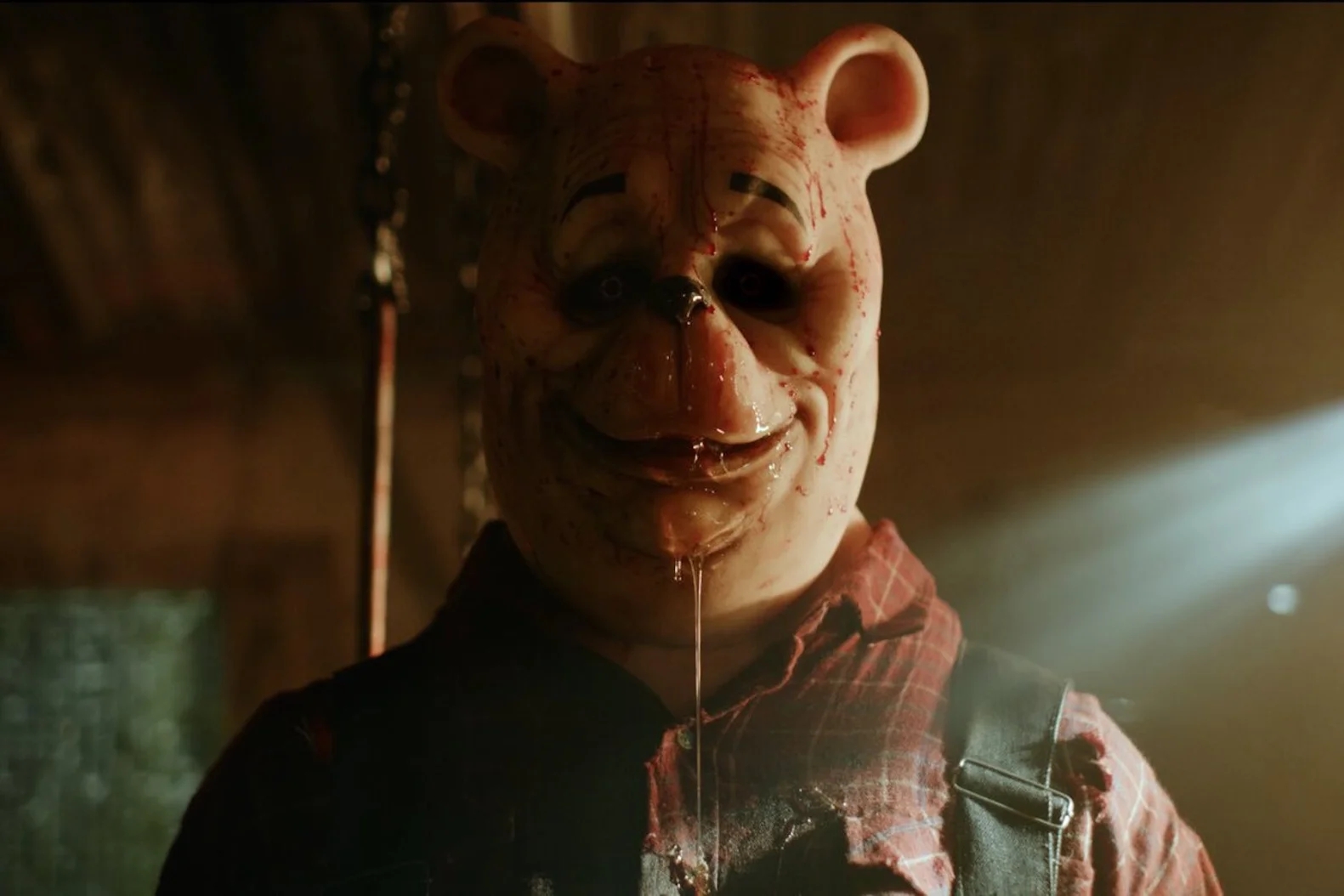
On January 1, 2022 the 1926 book “Winnie-the-Pooh” entered the public domain in the United States. In May of 2022 it was announced that an independent slasher starring the beloved children’s character Winnie-the-Pooh had been filmed, where the titular Pooh was now a feral monster on a killing spree. This week I paid for and sat through this movie. All I asked was that it be fun. And it’s not awful. In fact, the premise is quite good. But on a technical level, “Winnie the Pooh: Blood and Honey” is a hot, sticky mess.
First, the good stuff. The introduction revolves around Christopher Robin and the entire Hundred Acre Woods crew (expect for Tigger, since Disney still owns the rights to the name and likeness). One day, Christopher leaves for college and Winnie-the-Pooh, Piglet, Eeyore, Rabbit and Owl feel abandoned. They don’t know what to do with themselves and at one point begin to starve and must eat Eeyore in order to survive. After that, they feel irreversibly betrayed by Christopher and vow to kill any human who enters their path. To make things even better (for those who are as into this premise as I am) this introduction, taking place within the first few minutes of the movie, is told entirely in an almost Frank Miller inspired black and white animated montage; with full proper British narration. In this animated sequence, while short and sadly the only aspect of this movie that I would say is rewatchable, I immediately caught a glimpse of the shockingly high potential that a film like “Winnie the Pooh: Blood and Honey” had.
Now, the rest of the movie, which is a live-action straight-forward slasher, sees a group of female friends travel to a vacation cottage near the Hundred Acre Woods, where they are subsequently terrorized by a bloodthirsty Pooh and Piglet. This “rest of the movie” also leads me to why this movie doesn’t work.
Writer/director Rhys Frake-Waterfield wanted this to be “The Texas Chain Saw Massacre” or “Friday the 13th” so badly. He just didn’t have the technical abilities to pull it off. Many of your favorite slasher movies are considered “low-budget”. And while “Winnie the Pooh: Blood and Honey” is admittedly lower budget than most modern slashers, it fails on three aspects that are all the result of bad filmmaking and thus render most of the movie unwatchable. First, the sound mix is poor. As the action commences, it is accompanied by a very standard horror score. The problem is, the score is louder than any actor speaking. So, for about thirty minutes of this movie it’s nearly impossible to hear what anyone is saying. Now, it’s a slasher, so the dialogue may not matter. But what does matter is the lighting. As soon as it becomes dark and the characters make their way outside, everything becomes hard to see. So, for many of the chase sequences, it’s a struggle to know who is where and if they are getting away or not. But none of that is as big of a problem as the movie’s most egregious flaw. It seems that nobody on set knew how to film a murder. Many independent slashers have done a great job of filming murder sequences using camera tricks to hide that fact that they lacked a budget to recreate the visuals necessary. What ‘Winnie the Pooh: Blood and Honey” suffers from is a lack of talent and experience behind the camera. Any practical effects, when used, were poorly filmed. And many kills not relying on gore are presented in a way that will leave audiences confused as to whether the person murdered is dead or even hurt at all. This aspect is only compounded by that fact that a few of these kills had halfway decent set-ups. But when you know that the kills are going to continuously result in the least satisfying outcomes, after a few of them you cease to be invested in anything happening on-screen.
Final Thought: The pre-production of “Winnie the Pooh: Blood and Honey” is a far more interesting thing to talk about than the movie itself. That said, get a better director and someone who knows their way around practical effects for the sequel, and I’m definitely here for that.
Follow me on Twitter @moviesmarkus and on Instagram @moviesmarkus1


 MOVIESMARKUS