Going into this I’d only seen a few episodes of Kane Parsons’ viral online series, but I do remember the feel of it reminding me of a modern-day The Blair Witch Project. And not solely because of the handheld, found-footage, VHS aesthetic, but also the overall “I don’t think we’re supposed to be watching this” feeling ever-present in his productions. Creating the series when he was 16-years-old and hired at 19 by A24 to direct a feature-length adaptation, at only 20 years of age Parsons’ vision hits the big screen.
Not fully abandoning his grainy VHS style wheelhouse, the story does begin with a handheld camera sequence, a great entry point no matter if you are viewing as a fan or had never heard of Backrooms before. Basically, you don’t have to have seen any of the series before watching the movie.
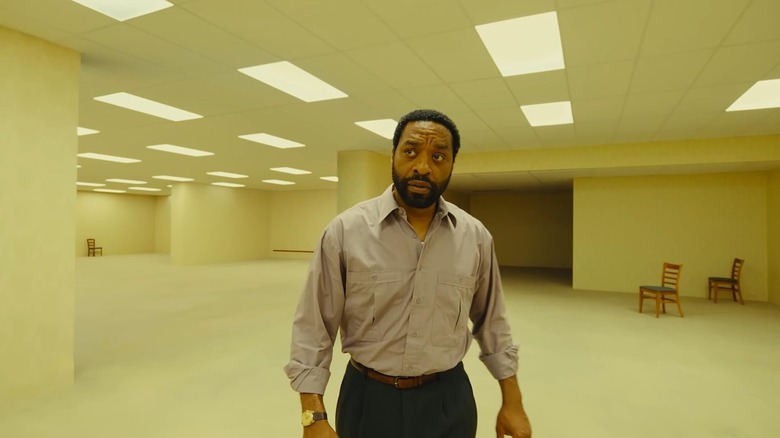
The main story is shot more cinematically, set in 1990 where we follow Clark (Chiwetel Ejiofor) a furniture store owner whose life has fallen apart. He’s been kicked out of his house and now lives in his store. He sees a therapist named Mary (Renate Reinsve) and makes lackluster attempts to work through the anger and resentment he has towards his ex-wife. One night, during a random power outage (power surge) Clark catches a sliver of light coming through one of the walls. When he puts his hand to it, he falls through revealing a seemingly endless series of fully lit office/department store style rooms on the other side. These rooms are recognizable as the soleless innards of the spaces you may be picturing (accompanied by the familiar buzz of fluorescent lighting), but every room is slightly off. One room might have a bunch of furniture stacked in the center of it while another has a door in the floor, or a chair half sunken into the ground, or a stop sign randomly cemented in the middle of an entrance way. But what is this space? Is it a maze? Or an alternate dimension? And is there something else in there with him?
If you’ve ever worked a closing shift in retail or found yourself working late in an empty office, you will be familiar with the unsettling feeling of occupying a commercial space designed for human activity that suddenly seems abandoned. This eerie idea of liminal space permeates the entire film.
With Backrooms, Parsons achieves his goal of creating a feature length episode expanding on the original series. His strong vision which contains a myriad of well-choreographed surreal sequences, visually pulling from such places as The Texas Chain Saw Massacre and David Lynch’s dreamlike aesthetic, will be the reason for this film’s success.
The main story revolving around mental health is the flattest aspect of the movie. Not to say that Parsons’ attempt at linking the therapy stuff to the events happening in the backrooms doesn’t work. But some of the exploration of childhood trauma/emersion therapy ideas tackled in the Clark and Mary sections as well as a lot of their dialogue generally comes off as a bit too on the nose and uninspired for a movie this visually adventurous and strange.
Final Thought: This is a film where the visuals carry the story. Which makes a lot of sense since Backrooms was born out of a series that was driven by its visuals rather than dialogue or characters. Again, I’m no expert, I’ve only seen a few episodes. But in regards to the film, having characters or even the story itself overshadowed takes very little away from the viewing experience. In fact, in a movie littered with well-thought-out sequences, the final dialogue free minute of Backrooms was a real “aha moment” for me. A door opening moment revealing some larger more profound ideas at play and elevating my entire viewing experience, giving me a real paranoid feeling walking out of the theater. And that is all I could ask for after watching any well-made horror.
Follow me on Twitter @moviesmarkus


